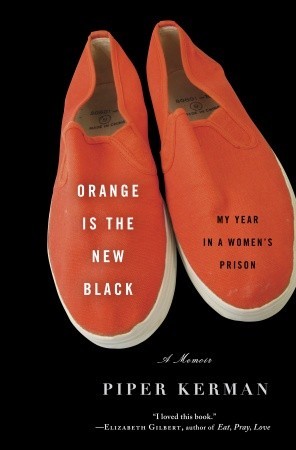
Book Review #32: “Orange Is the New Black: My Year in a Women’s Prison”

Orange_Is_the_New_Black_book_cover

Image Credit: Wikipedia

At the end of April, during a long weekend with Al and his parents, I found this paperback while visiting the Virginia Avenue Mall in Clarksville, Virginia. There were so many books – It was a really cool indoor, two-story flea market. I was hunting for something else, but for $4.00, I couldn’t pass this up!

I haven’t watched the series on Netflix, but I’ve always been curious about it. I knew it was based on a true story / inspired by true events, but I didn’t realize that Piper Kerman had written a book about it!

This was another book that I finished quickly, but forgot to write the review. I’m trying really hard to break this habit! I think it only took me about two weeks to read.

It was crazy to read about how Piper’s unfortunate globe-trotting escapades caught up with her several YEARS later. She was sentenced to 15 months in federal prison, and served her time in three different facilities.

Having only learned about prison from books and other media, reading a first-hand account from a woman who was not a typical inmate was eye-opening, and oddly fascinating. I say “not typical” because Piper was well-educated (She graduated from Smith College before getting involved with her criminal activities), and had an immense support system on the outside.

She did a fantastic job of painting the experience for the reader – I felt like I was right beside her the entire time. I really got to know Piper, as well as all the women around her. I went through many emotions – I laughed, I teared up, I wanted to scream. Mostly, I laughed. I personally think Piper tried to make the very best of her not-so-desirable situation, and I think she handled it really well.

I didn’t want to put the book down. I started to limit myself to only 1-2 chapters per night, because I wanted to read 5-6. It’s no wonder that this book has transformed into a successful series on Netflix.

Kerman did a great job with details, and made sure that the reader got as much of the full experience of her 15 months between Danbury, Connecticut; Oklahoma City; and Chicago as possible. It was also really interesting to go back in time, in a way, reading about headlines and news from 2003 through 2005.

She displayed a significant amount of courage by writing this book. She gives the reader an inside look into a tough place, and she does a really good job of showing honesty, sympathy, and advocacy.

I highly recommend this book. It’s definitely not the easiest read, but it really opened my eyes. I have a better understanding of what these women go through, and how those on the outside should be better about treating them. There’s still a huge stigma around incarceration, and these women deserve better.

5 out of 5 stars.


Until the next headline, Laura Beth 🙂
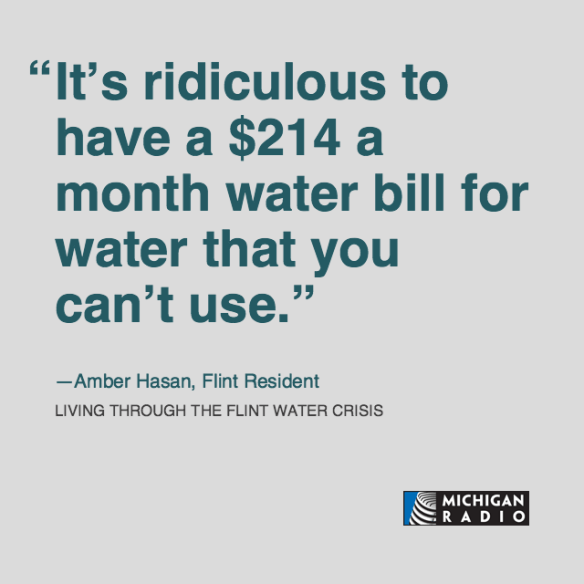
Hot Topic #19: The Water Crisis in Flint, and Others

quote-its-ridiculous-to-have-a

Image Credit: Michigan Radio

This particular issue has been running through my veins for a good while now – No pun intended.

The purpose of this post is to review the events of what’s happened with the water in Flint, Michigan. In addition, I want to highlight other cities that have or have had their own water crises.


In my humble opinion, this is simply unacceptable. Everyone needs water to survive!

According to the U.S. Environmental Protection Agency (EPA), a person can live about a month without food. However, one can only survive about a week without water.

Lack of clean, safe water leads to further illness and disease, and ultimately, death.


Flint, Michigan

One of the most recently updated articles about the crisis in Flint comes from CNN:

In a nutshell, the city officially switched water sources in 2014. At that time, Flint’s water supply fund was $9 million in the hole. Flint has gotten its water from Lake Huron since 1967. But, nearly three years ago, the source was switched to the Flint River while a new pipeline was under construction.

The Flint River was not being treated with an anti-corrosive agent, which violates federal law. Because this agent was not added, when the supply was switched over, lead from old pipes started to contaminate the water.

Lead exposure is known to cause adverse health effects, particularly in children and pregnant women. There are medicines that reduce the amount of lead in the blood, but further treatments have not been developed.

Since then, it’s been disaster after disaster. Finger-pointing back and forth, multiple lawsuits, and tons of bureaucratic red tape. All the while, the residents have been holding the bag – All they want is to be able to use their tap water again.

Among other things, tests have come back positive for horrifying things over the last few years, such as Legionnaire’s disease, total coliform bacteria, disinfectant byproducts, and bacteria buildup. Even Flint’s General Motors plant stopped using the city water because high levels of chlorine were corroding engine parts.

Flint has been in the spotlight for another reason – About 40 percent of its residents are African-American. There have been multiple claims / allegations that race has been a factor in the crisis, as well.

Here’s some more information. The timelines were immensely eye-opening.


Other Cities in the U.S.

After the Flint crisis broke loose, other cities in the U.S. started reporting elevated levels of lead in their water supplies.

A simple Google search of “water crisis in America” immediately hits upon an article, dated March 2016, from CNBC, titled, “America’s water crisis goes beyond Flint, Michigan.”

Another startling article, titled, “America Is Suffering From A Very Real Water Crisis That Few Are Acknowledging,” is more recent. This was published just a few months ago, in January. It cites several sources, but most striking is one report from Reuters that states shocking statistics. There are 3,000 localities in the U.S. alone that have lead levels at least double the amount in Flint.

That’s just insane.

Like Flint, many of these communities have what’s referred to as “legacy lead,” meaning that most are former industrial hubs that have crumbling paint, old plumbing, and industrial waste.

However, many of these localities have not been in the national spotlight. Most of these areas have had to fight the poison on their own.

With that said, there are multiple problems here. There is data showing contamination, but funding has not been increased or allocated to fix the plumbing, pipes, or water supplies. While recent focus has been on lead, there are water supplies all over this country that are tainted with numerous hazardous metals and elements (mercury, arsenic, chlorine, etc.), bacteria, and other things that are far from safe.


Around the World

It’s no secret that other cities and countries on our planet don’t have regular access to clean, safe drinking water.

A quick Google search lists numbers of at least 1.1 billion people on our planet that have scarce water.

Here’s several links that illustrate the worldwide water shortage:


What Can We Do?

At this point, you may be feeling helpless, or confused, or sad. So, what can we do?

  • There are multiple charities that are dedicated to providing safe, clean water to water-scarce areas.
  • Educating others about these issues.
  • Spreading awareness.
  • Harvesting rainwater.
  • Researching and advocating new technologies.
  • Decreasing the effects of climate change.
  • Pursuing cleaner means of energy.
  • Consuming products that use less water.

Source: Conserve Energy Future

We may not be able to change the world right now, but educating others goes a long way!


Until the next headline, Laura Beth 🙂
Hot Topic #18: What’s Up With Washington?

4.1.1

Image Credit: InspirationSeek.com

Disclaimer: This post contains strong language.


Sigh.

I’ll admit, I’ve put off writing a post like this. I try to be an optimistic, positive, and enthusiastic person. I also try to bring those qualities to my writing, and the blog. There’s so much doom and gloom and bad news!

However, I cannot be silent anymore.

My shock has finally lessened, and I’ve accepted that Donald Trump is the 45th President of the United States.

Does “accepted” that mean that I agree with it? Does that mean I’m okay with it?

Absolutely fucking not.


What I mean (or what I’m trying to say) is that I know / understand that Trump is our President now, and we all have to deal with it.

As I’ve attempted to write this post in a coherent manner for a great many days, I’m just stunned at how literally everything has changed since November.

Nearly four months ago, our country was preparing for / bracing itself to find out whether a billionaire businessman, or a powerful woman, would be elected to lead our great nation.

When I woke up on Wednesday, November 9th, my greatest fears were realized. I immediately felt sick. No, scratch that. I felt like shit. I could barely process the barrage of CNN News Alerts on my iPhone. I didn’t want to go to work. I wanted to curl up in a ball, terrified of what just happened and scared as hell for whatever was going to come next.

But, through it all, I held my head high.

I’ve had several fascinating, informative, and civil discussions with my husband, my dad, my manager, and a handful of others. I’ve attempted to swim through all the media coverage and social media discourse, and come to my own conclusions.


I want to share what I think.

Bear with me, this may get a bit lengthy.

Yeesh, you guys. I can’t even number this list – I just have no clue where to even start.

Okay.

Deep breath.

Here we go.

  • Healthcare: It’s maddening to think that they think they can simply “repeal and replace” the Affordable Care Act. It took SIX YEARS – Yes, that long – to enact what’s currently in place. I want evidence of their so-called solution. For more, see Hot Topic #17.
  • Jobs / The Economy: It’s nice that certain companies have said, “Yes, we’ll keep our plants / facilities in the U.S.” Will that actually happen? Who knows.
  • Immigration: His immigration ban already failed once. We shouldn’t be focusing on the countries he’s listed. The U.S. has its own problems! Plus, there are millions of refugees trying to escape terrible wars, famine, and more. Shouldn’t the U.S. government be a bit more compassionate? The FBI and the military have been focusing on terrorism since September 11, 2001 – We shouldn’t be stopping immigration based solely on fear.
  • “The Wall”: I roll my eyes and snicker every time I hear about this. This is not the answer. This is not the solution!
  • LGBTQ Rights: I’m going to borrow a quote I’ve seen on social media in the last couple of days: “It’s not about bathrooms, just like it was never about water fountains.” More to come about this, in a future blog post, or two.
  • The Dakota Access Pipeline: Everything else in Washington seems to be pushing this issue to the back burner, which makes me mad! For more, see Hot Topic #16.
  • Crime: Trump needs to get over himself, attend his daily briefings like all other Presidents in the history of our country have done, and stop using alternative facts and/or fake news. The inflated crime statistics, the 45-year-high murder rate – Nope. Try again. FALSE.
  • Relations with Russia: Once again, John Oliver is fucking brilliant. Check out his most recent episode of Last Week Tonight: Putin.
  • The Media: I lead you to John Oliver again: Trump vs. Truth. Also, the most recent frightening development – Yesterday, when several news organizations (CNN, The New York Times, The Los Angeles Times, Politico, BuzzFeed, The Guardian, and the BBC) were outright BANNED from the White House press briefing? Yep, that’s absolutely terrifying. In that same article, Trump was quoted as saying that “… much of the press represents ‘the enemy of the people.'”
  • Planned Parenthood: Voting to de-fund Planned Parenthood because they perform abortions? Oh, my God. Give me a break! ZERO federal funds are used for abortions – Not one penny. Here’s the simplest explanation I could find: How Federal Funding Works at Planned Parenthood. For more, see Hot Topic #12.

Well, readers, this is all I can muster to write, for now. Thanks for reading / listening. You all mean the world to me.


Until the next headline, Laura Beth 🙂

Book Review #28: “The Underground Railroad”

the-underground-railroad

Image Credit: goodreads.com

I first heard about this book when Colson Whitehead was interviewed on NPR’s Fresh Air back in August 2016. It’s one of several podcasts that I subscribe to, and I’ve learned about a lot of books, both new and old, in this way.

It took me a long time to finish this book. Not that I was in a hurry, but it was a tough book to read.

Whitehead took one of my childhood thoughts – That the “Underground Railroad” during the time of slavery in the U.S., was a real railroad – and turned it into a fascinating, yet heartbreaking story.

I can’t say much in this review without giving away potential spoilers, so I’ll keep this brief. I enjoyed Whitehead’s world-building, how he created the characters, and how he wove historical accuracy into an alternative reality.

I imagine he researched for a long, long time, to make sure certain parts of this story were as accurate as possible, at least for the time periods that were being viewed.

There’s so much emotion packed into this one book – Fear, anger, sadness, joy, trust, love, to name a few. He weaves horror into relief, courage and bravery into fear, love into disappointment.

There’s a little bit of everything in this book – Pulse-pounding action, a dash of romance, lots of drama, and a bit of thriller.

I look forward to reading more from him, in the future. I need a few days to recover from this amazing, yet horrifying piece of literature.

5 out of 5 stars.


Until the next headline, Laura Beth 🙂

Book Review #26: “Ghettoside: A True Story of Murder in America”

ghettoside

Image Credit: amazon.com

“This is a book about a very simple idea: where the criminal justice system fails to respond vigorously to violent injury and death, homicide becomes endemic. African Americans have suffered from just such a lack of effective criminal justice, and this, more than anything, is the reason for the nation’s long-standing plague of black homicides.”

~Jill Leovy, Ghettoside: A True Story of Murder in America


I picked up this book less than a month ago, when I was in Barnes & Noble, deciding what to get (rather, how many books I could get) with the generous gift card that Mom and Dad gave me for Christmas.

I think this was on the “Recommended Reading” shelf – Plus, the 20 percent off sticker didn’t hurt, either.

I’ve been interested in true crime stories for a long time. It’s fascinating to see stories unfold on TV – Castle, Cold Case, Law & Order: Special Victims Unit, Criminal Minds, NCIS, CSI: Crime Scene Investigation, and so on. But, most of the time, the stories we see on shows like these are fictionalized. Some are based on true stories, but most are created by writers.

This book initially caught my attention because of the title. I was asking myself, “Okay, what is ‘Ghettoside?’ That sounds interesting.”

The story Leovy, a reporter for The Los Angeles Times, writes is full of twists and turns. She follows John Skaggs, a Los Angeles Police Department (LAPD) homicide detective, as he works to solve the murder of Bryant Tenelle. Bryant was 18-years-old when he was shot in 2007. Bryant was also Wally Tennelle’s son – A LAPD detective assigned to Robbery Homicide Division (RHD).

She goes deep into some of Los Angeles’s worst areas – Watts, south of the Ten, and so on. But, she tries to dispel some stereotypes and myths along the way. She identifies several of the worst gangs in the area, and tries to figure why black men kept killing black men. It’s evident that she’s a talented researcher, as well as a writer.

I could tell, almost immediately, that this book took a long time to write. Leovy spent years on this book. Simultaneously, she was attempting to capture and track every homicide in Los Angeles County, in real time.

Ghettoside was riveting. It has a few weak points – There were a lot of characters introduced early on, and it was difficult to keep up at first. I found that I had to stop myself early several nights, because I didn’t want my brain to be overloaded, even though my brain wanted me to keep going. The timeline flipped and flopped a few times.

I felt every emotion while reading this book. Some scenes almost made me sick; Leovy is incredibly detailed. This book is not for the faint of heart. She writes graphically at times, but only to hammer home the point at hand. She wants to emphasize how awful these homicides are. She does a tremendous job of capturing emotions from the characters involved – The LAPD, the grieving families, witnesses who are terrified to testify, and even the prosecutors.

In addition, she shines a spotlight on divisions within the police department that are frustrating to many. It’s evident there’s still work to be done.

Fortunately, progress has been made. Homicide rates in the area have fallen dramatically. Leovy appears pleased and proud of the work that’s been done. She strikes a good balance of narrative and statistics – A balance that kept me reading several chapters a night.

It would be interesting to have a follow-up book several years from now, to see what’s changed.

4 out of 5 stars.


Until the next headline, Laura Beth 🙂

Commentary #46: How The U.S. and Others Work with Mental Health Issues (Follow-Up to “A 700-Year-Old Haven for Mental Health”)

quote-on-mental-health-91-healthyplace

Image Credit: HealthyPlace.com

Back in October (Wow! Where did the time go?) I wrote a post about the amazing town of Geel, Belgium, and their remarkable approach to mental health and helping those in desperate need of care.


In case you missed it, here’s the link to the original post:


In my original post, I mentioned how I wanted to research how the U.S., other countries, and even other continents approach mental health issues, and how they are addressing them.

Are they like Geel? Or completely different?

It’s taken a long time to compile this research, so bear with me. My eyes have certainly been opened!


Through my research, it’s become clear to me that the United States in particular has a long, long way to go before reaching a place like Geel. Stigma is everywhere. However, I found some encouraging articles and resources.

The Washington Post published an article entitled Three innovative ways to address mental health issues in June 2014. This article focused primarily on children’s mental health, but this is as equally important, if not more so, to devote time and resources as adult mental health.

Published through Samford University in Birmingham, Alabama, the web page titled Community Recovery in the United States was intriguing. There are established programs modeled after Geel in the U.S., but only in certain states. This makes me wonder if there could be community recovery programs eventually established in every state, so that anyone can have access? Granted, this page has not been updated since 2009, but still, I like that these resources have been highlighted.

In Philadelphia, Pennsylvania, Temple University has created a unique Rehabilitation Research and Training Center that focuses on helping those with psychiatric difficulties be independent in their communities: Temple University Collaborative on Community Inclusion of Individuals with Psychiatric Disabilities.


Around the world, there are several organizations that have mental health initiatives. However, there is still much work to be done to help those with mental disorders.

In an article from Wake Forest University in North Carolina from November 2009, Addressing mental-health issues around the world discussed the Mental Health Facilitators (MHF) program that started through a request from the World Health Organization (WHO).

From the Huffington Post in April 2016, Addressing Global Mental Health Challenges and Finding Solutions was a blog post about the author’s work with the International Medical Corps and other non-government organizations (NGOs) to help address these crises all over the world. In 2016, it’s incredibly sad that nine out of 10 that have mental disorders do not receive basic treatment.

Published on August 1, 2016 by the BJPsych Bulletin (Royal College of Psychiatrists, a charity registered in England, Wales, and Scotland), this fascinating article entitled Lessons to be learned from the oldest community psychiatric service in the world: Geel in Belgium was an exploration of the family foster care model that’s worked for so long.


On December 14th, I discovered some encouraging news from my own state of Virginia:

This was published by Richmond news station WRIC.

I read and re-read this article, at least three times. This proposal is full of promise, but it’s just a proposal. Thirty-one million dollars is good chunk of change, but I’m a bit skeptical. I hope it will come to fruition, but it’s going to take time.

I plan to keep following this particular story very closely.


In addition, here are other resources that you may be interested in:


Final Thoughts

It was frustrating and a bit disheartening to write this post, hence why it took so long to finally publish. As someone who has Generalized Anxiety Disorder (GAD), it’s hard to read statistics and stories that show so limited resources, historically, being dedicated to mental health.

However, I’m happy that more attention is being given, and that more organizations are working every single day to make changes. I’m glad there are resources available to many, but it would be nice to see equal resources be available to all. That herculean effort takes time, money, and dedication.


Until the next headline, Laura Beth 🙂

Book Review #20: “Smashed: Story of a Drunken Girlhood”

smashed

Image Credit: amazon.com

“I’d written Smashed not because I was ambitious and not because writing down my feelings was cathartic (it felt more like playing one’s own neurosurgeon sans anesthesia). No. I’d made a habit–and eventually a profession–of memoir because I hail from one of those families where shows of emotions are discouraged.”
― Koren Zailckas, Fury: A Memoir


Like other books that I’ve reviewed on the blog, I picked up this book in a thrift store. I can’t remember when, but I was drawn to it almost immediately.

This is one of those books that I will keep forever. I think I first read it in high school, but it’s been a good one to re-read.

Koren takes us through her journey with alcohol. She started drinking at age 14, and stopped at 23. I applaud her courage to attain sobriety!

Three words come to mind when I think of her writing: Raw, unapologetic, and real.


Reading this book in high school, I remember thinking to myself, “Well, when I go off to college, I won’t be like that. I won’t go crazy and drink a lot. I might join a sorority, but I’ll be careful.”

Oh, high school Laura Beth. You ate your words.


Let’s back up a bit. I was raised in a family that always had beer and wine in the fridge. Dad usually drank a beer every night after work. Mom enjoyed a glass of wine most nights.

I had my first sip of beer at age 10 in my parents’ kitchen. I was curious, and Dad said I could taste it. Mom was appalled. It was one sip of Natural Light, and it almost made me puke. Despite Mom getting upset, I’m glad that Dad gave me that chance, because after that I told myself I didn’t want to taste that again until I was 21. (In college, I instantly recognized the true nickname of “Nasty Light,” although most frats had it on hand because it was super cheap).

I was allowed small amounts of wine before I turned 21 in the presence of Mom / Dad. It made feel good, and I started to understand how Dad having a beer was a method of relaxation and unwinding after a hard day’s work.


When I first went off to college, alcohol was not on my personal radar. The school was/is very strict about alcohol, with a three-strike policy and education courses if violations occurred. Plus, I knew Mom and Dad were footing most of the bills, and I didn’t want to jeopardize any of that.

However, under the influence of John for three of my four college years, alcohol was involved. My university has a bit of reputation as a party school, being in a small-ish town, and a good majority of students are in sororities and fraternities.

I remember re-reading Smashed at least twice while in college, once before I joined Alpha Sigma Tau (AST), and once afterward. It was a striking experience, to say the least. Through Koren’s words, I started to realize how sororities, fraternities, and alcohol mixed and blended together.

I went to several fraternity parties during my four years in school, before and after turning 21, and before and after joining AST. (I turned 21 in August 2009, and joined AST that fall.) As I got older, however, I realized that I didn’t need alcohol to be sociable. Eventually, I started to feel immense disgust at these parties because everyone was getting drunk, wasted, and being incredibly stupid. It was unattractive. I usually remained sober so that I could keep an eye on my younger sisters and make sure no one got into serious trouble. It was embarrassing.


Throughout my college experience, I learned a few things along the way:

  • Liquor is cheap, and it’s super sweet.
  • I’m definitely a lightweight.
  • I never truly blacked out at all, but there was one sorority party where I was asked to leave (I learned later it was mainly because of the friends with me, and not me personally), and I passed out cold in my bed. I woke up 12 hours later.
  • I was the designated driver for one Saturday night for AST as a senior, and I vowed to never do it again. Seeing several of my sisters wasted was something I did not want to see.
  • I can clearly see the attraction to alcohol, and it almost makes me sick.

Now, nearly six years removed from college, I can clearly see a culture of alcohol. Not only at my university, but at most other colleges and universities across the U.S. It’s tough to swallow.

Sure, going away to college is a rite of passage, and alcohol is usually involved at some point for nearly every student.

However, I don’t like the idea of getting drunk. To me, it’s sloppy and irresponsible. Also, too many innocent people get hurt or die every day because of drunk or intoxicated drivers.

I do drink, but only occasionally. Alcohol is expensive, and I rarely justify having it in our house. Al doesn’t drink, and that’s been a great thing for me. I usually indulge during parties or social events, but I always have Al drive. If I do drink, I make sure that I eat plenty of food and have water with me. Alcohol does relax me, but I believe that I know my limits.

I like certain beers and usually don’t discriminate with wine, but I stay clear (run away almost) from the liquor and mixed drinks – Too many painful college memories. Plus, it’s too sweet for me.


Reading Koren’s words at age 28 was also a different experience. I’m glad that I’ve read this book multiple times. It’s made me reflect on different aspects of my life, and how I’m grateful that my own drinking has never truly spiraled out of control. However, I’m glad that Koren had the courage to write this book, tell her story, and help others. I’m glad that she has achieved sobriety, and that she is a successful writer.

Koren’s memoir is one that will always be relevant to me, even though it was published 10 years ago. She’s a gifted writer, and I look forward to reading Fury: A Memoir some day soon.

4 1/2 out of 5 stars.


Until the next headline, Laura Beth 🙂

Hot Topic #17: The Affordable Care Act

There’s been a lot of chatter online recently regarding the Affordable Care Act (ACA).

I started writing this post about two weeks before Election Day. It’s only been 17 days since that day, but the whole world has now changed.

Like many people, I was stunned at the outcome. I know that the ACA is now under a stronger microscope now, more than ever.


Full disclosure: I work for a health system in Virginia. For the last four years, I have been immersed in the world of healthcare and the insurance companies. My department helps negotiate the contracts between the health insurance companies, and our health system.

As with all of my blog posts that involve research and sources, I try my best to be well-read and as well-informed as possible.


The official name for the ACA is the Patient Protection and Affordable Care Act (PPACA). It was signed into law by President Obama on March 23, 2010.

There were three main goals with enacting the PPACA:

  1. Increase health insurance quality and affordability
  2. Lower the uninsured rate by expanding insurance coverage
  3. Reduce the costs of healthcare

The law requires health insurance companies to accept all applicants, cover a specific list of conditions, and charge the same rates regardless of pre-existing conditions or sex.


On a positive note, the law has appeared to help reduce the number of Americans without health insurance.

According to the Centers for Disease Control and Prevention (CDC), the percentage of people without health insurance was 16.0 percent in 2010.

Between the period of January-June 2016, the percentage of people without health insurance was down to 8.9 percent.

That breaks down to a 7.1 percent reduction. Dividing that by six years, it’s been roughly a 1.18 percent reduction since the law was enacted.


In March 2016, the Congressional Budget Office (CBO) reported that 23 million people now have insurance due to the law.

Those 23 million people break down as follows:

  • 12 million people covered by the exchanges (10 million of those received subsidies to help pay for their insurance).
  • 11 million made eligible for Medicaid.

I’m going to stop for a second and try to answer some questions that may have arisen with what you just read.

What are the exchanges?

  • They are regulated marketplaces, mostly online, where individuals and small businesses can purchase private insurance plans.
  • They are in all 50 states.
  • They are administered by either the federal or state government.

What are subsidies?

  • Subsidies are money, in the form of a refundable tax credit, made available to certain households. The U.S. has a federal poverty level (FPL), and households that have incomes that equal a certain percentage of the FPL can get help to purchase insurance on the exchanges.
  • For example, in 2014, the FPL was $11,800 for a single person, and $24,000 for a family of four people. Households with incomes between 100 percent and 400 percent of the FPL were eligible.
  • $24,000 x 133 percent (1.33) = $31,920 per year income. The maximum insurance premium that family would pay was $992 for that year. The family could also be eligible for a little over $5,000 in subsidies.

What is Medicaid?

  • Medicaid is a government program that helps provide health insurance for people with low income, such as adults, children, and people with certain disabilities.
  • One caveat of the PPACA is that Medicaid expansion was left up to the individual states. Virginia, for example, is one of the states that chose to not expand Medicaid.

It’s tough to wade through all of this information. I can see why there have been numerous challenges and criticisms of the ACA. It’s been six years since it’s been enacted. Even though I work for a health system and I work with the health insurance companies on an almost-daily basis, it’s difficult for me to try to explain all of this.

I feel extremely fortunate that my employer offers health insurance that covers almost all of my needs. The premium is taken directly out of my paycheck, and my out-of-pocket costs are relatively low. There are certain things, such as my chiropractor visits and dermatology procedures, that are not always covered, but I’m fortunate to have a good job that allows me to pay those bills. I feel at peace, knowing that if I had to go the emergency room or be admitted to the hospital any time soon, that my insurance would be able to cover me.

Because of my job, I’ve tried really hard to immerse myself in learning about the ACA and how it works, or how it’s supposed to work. By educating myself, I’m able to think and speak more intelligently about it, and try to think ahead. The world of healthcare is constantly changing, nearly every day.


I’ll leave you with a list of resources that I used while constructing this post. I hope this post was educational, informative, and helpful.

I certainly don’t know everything, but I definitely like to learn.


Until the next headline, Laura Beth 🙂

Commentary #45: A 700-Year-Old Haven for Mental Health

44509306

An aerial view of Geel, Belgium. Image Credit: Tripwolf

“She made broken look beautiful and strong look invincible. She walked with the universe on her shoulders and made it looks like a pair of wings.”

~Unknown


Thanks to Facebook Memories earlier this week, I was reminded of an exceptional town in Belgium that has adopted a completely different approach on helping those that need help with their mental health.

Here’s the link to the original story:

I shared this story on Facebook in October 2015. I remember reading with great interest at the time, but then I filed it away in my brain.


Then, at the beginning of July, Geel re-entered my life.

Remember my recent post on podcasts?

One of the seasonal ones is NPR’s Invisibilia. I kept hearing about it in promos during other NPR podcasts. I subscribed in the spring of 2016, eager to listen to season 1 and prep for season 2.

Then, on July 1st, they released the episode titled, “The Problem with the Solution.”

The episode focused on Geel, and how the hosts went to Belgium to see this idea for themselves.

I remember being rapt with attention in my car during my work commute, hanging on every word.

I couldn’t get it out my head.


Seeing the article from Upworthy made me curious about how the U.S. helps those with mental health issues. Other countries and continents, too – Not just Europe. I’m thinking about Africa, Asia, and Australia. What about China, or Japan?

Over the next few weeks, I plan to research this and do a follow-up post with my findings.


Final Thoughts:

I find Geel’s approach fascinating. It’s interesting that the boarding population has decreased to due a reduction in the number of host families, but I think that’s part of the cycle. The inference that there’s a decreased need for farmhands makes sense.

It’s hard to believe that this one town has done this giving for 700 years, but i think it’s awesome. I’m excited to do more research, to see how the U.S., Canada, and other countries work with mental health issues.


Until the next headline, Laura Beth 🙂

Book Review #19: “Go Set A Watchman”

us_cover_of_go_set_a_watchman

Image Credit: en.wikipedia.org

“Prejudice, a dirty word, and faith, a clean one, have something in common: they both begin where reason ends.”
― Harper Lee, Go Set a Watchman


This is the third book from my 2016 Reading Challenge!


I bought this book almost immediately after it was published.

To Kill A Mockingbird is near the top of my all-time favorite books – One that I re-read almost every year. When this manuscript was discovered and then published, I knew I needed to get my own copy.

I was immediately attracted to the cover. It’s gorgeous, classic, and something that I think will stand the test of time.

Please note: I will do my best to limit spoilers in this review, but this is your formal warning.


I’ll admit, I read too many articles surrounding the publication of this book in the summer of 2015 – Something I don’t normally do.

There was one significant character detail, surrounding Atticus, that was a bombshell. To me, it came completely out of left field, especially given the events from Mockingbird.

It’s so significant, that I choose to not reveal it here.

However, after I bought the book, I tried to shelve that bombshell and read it with an open mind.

It took me over a year to sit down and read it, but better late than never.

Go Set A Watchman reintroduces the characters of Atticus, Calpurnia, Hank, and Scout, now referred to as Jean Louise Finch. Lee takes us along for the ride with Jean Louise, as she travels from New York to her hometown of Maycomb, Alabama. She visits for two weeks every year.

I could see how the passage of years had changed everyone, and not necessarily for the better.

I was immediately immersed in Jean Louise’s world. She’s 26 now, and I saw the image of Scout fading and her womanly image forming throughout the book.

Having always enjoyed historical fiction, I appreciated Lee’s take on a typical Southern town, struggling to accommodate the black community and start to accept their burgeoning civil rights. The NAACP and Brown v. Board of Education are prominently mentioned, giving me the impression that the story is set after 1954.

Lee paints certain scenes so well that I felt like I was right there, listening to the local gossip in the livingroom during the Coffee. I could hear the train whistle. I could almost smell the marsh when Hank and Jean Louise go for their swim at Finch’s Landing.

At first, I sympathized with Jean Louise. She’s grappling with visiting her hometown that is struggling with so much change, while trying to keep her wits about her. The same condition that killed her mother has now killed her brother, Jem. She is horrified by her father’s actions at a Citizens’ Council meeting in town. She begins to lose her faith in everything that she thought she knew.

Most of the time, I wanted to keep turning the pages. It’s definitely a dramatic novel, exploring Jean Louise’s actions and reactions to her hometown and all the changes around her. She’s changing as a woman, as a daughter, and as a friend, plus trying to adapt to the world that is in flux.

However, toward the last section, it felt like Jean Louise’s two weeks in Maycomb were more like two years. There was so much dialogue, along with multiple large chunks of inner monologue and stream-of-consciousness, that got very muddy and tough to wade through.

To make sure I was following along correctly, there were several times where I had to pause and re-read some lengthy passages, and I didn’t appreciate that at all.

Also, there were several instances where the speaker or character wasn’t clear, and I had to review the previous passage or even the whole page of text to see who was being referenced. It was immensely annoying, frustrating, and made my head hurt. I kept reminding myself that the main focus of the novel is on Jean Louise, but, as a reader, it’s no fun having to try to figure out the character from page to page.

Overall, Go Set A Watchman is a decent sequel to a landmark novel such as Mockingbird. It clearly illustrates the struggles of the time, and how a 26-year-old woman would potentially adapt to so many changes in a short time period.

It has several excellent qualities – Love, family, friendship, morals, and balancing acceptance. I believe it accurately portrays the attitudes of those white, and black, of the time period, in the troubled South. It was an intriguing novelization of the deep South that made me consider how I would react if I had been in Jean Louise’s shoes.

However, it felt about 75 pages too long. Lee could have done without multiple pages of Jean Louise’s murky thoughts and memories. By the end, some of her outbursts and interactions with others appeared overly dramatic, immature, and frustrating. It was almost too heavy with her characterization, and I found myself wanting more of other characters, particularly Atticus, Hank, and even Calpurnia.

It’s a decent addition to my bookshelf, but not one that I will constantly praise and applaud for years to come.

3 1/2 out of 5 stars.


Until the next headline, Laura Beth 🙂