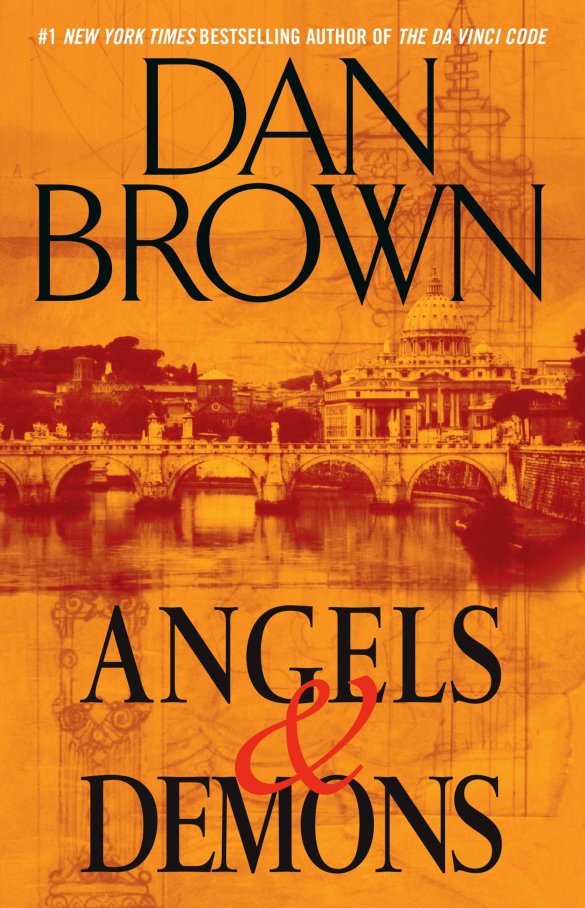
I originally thought The Da Vinci Code was the first book to feature Robert Langdon, but I was proven wrong!
This was a HUGE book. I wanted to finish it last week, but it was so dense that it took me until 11:00 p.m. last night to finally finish. It’s 616 pages total!
To be blunt, I have several praises, as well as several criticisms.
I was instantly drawn into Robert Langdon’s world. Brown hooked me within the first few sentences. I was along Langdon’s side from Harvard, to Switzerland, to Vatican City, to Rome. It was a bit of a whirlwind at first, and then you get plunged into the worlds of CERN, Vatican City, the Catholic Church, history, and symbolism.
Trying to figure out the puzzle that Brown laid out kept me interested. A scientist at CERN is brutally murdered, and he has connections to both the scientific and religious communities.
I liked Vittoria Vetra almost immediately. She’s feisty, gorgeous, and a great addition to Langdon. Langdon is the main character, but there were times that Vittoria was faster, and took control, and I liked it! She’s a smart cookie, and I knew Robert would be attracted to her.
The menagerie of twists and turns made me feel like I was on a high-speed ride through Europe! It was exhilarating. There were several days where I flew through multiple chapters and dozens of pages.
I applaud Brown’s dedication and commitment to historical accuracy, and being totally up front about not fictionalizing any locations, historical figures, or places (There’s a disclaimer in the very beginning). It felt even more real!
—
However, I had several issues with this book. There were three particular instances where I feel Brown is almost too graphic in his writing. As an aspiring writer of fiction, I know that, at certain times, it’s necessary to be graphic to illustrate and illuminate, But, Brown’s style was too much for this reader. I almost gave up every time. I almost didn’t want to find out what happened next. Some of it almost made me sick.
But, I pressed on.
Toward the end, as the intensity was reaching its peak in Vatican City, where decisions needed to be made quickly – Brown inserted this multiple-page speech by the Camerlengo (papal chamberlain) that just dragged on and on. I got the significance – The man was addressing the cardinals at a critical point in the conclave – but it could have been much shorter! Maybe dedicate a page or two, but not five or six! I felt so impatient during that section. I wanted to skip the entire speech and get just back to the action!
Finally, I hated the ending. It felt abrupt, it felt weird, it left me hanging a bit. It wasn’t a cliffhanger, but I hated how nonchalant it felt. I won’t give it away, but I felt a bit empty when I closed the book.
My first thought was, “That’s it? That’s how you end this ridiculously long book? Wow…”
After sleeping on it, I realized this morning why he ended it the way he did, but I still wasn’t happy about it!
—
If you’re looking for a thriller that involves conspiracy, mystery, secret societies, art history, exploring historic sections of Europe, and learning a lot about the Catholic Church – This book is for you.
Overall, I’m glad I stepped out of my comfort zone for this one. I’d heard of the movies, but haven’t seen them. The first few pages of The Da Vinci Code I read about a month ago made me curious about who Robert Langdon is and how he got himself into such a twisted web of history, religion, and murder. It’s an exciting book, and I’m looking forward to seeing more of him, and what happens next.
Despite my issues with Angels & Demons, I’m still motivated to read the other books with protagonist Robert Langdon – The Da Vinci Code (2003), The Lost Symbol (2009), Inferno (2013), and Origin (October 2017). Look for these reviews over the next few months.
3 out of 5 stars.
Until the next headline, Laura Beth 🙂






 Hot Shot Headlines
You must be logged in to post a comment.